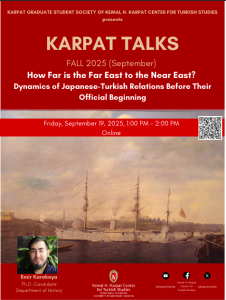
How Far is the Far East to the Near East? Dynamics of Japanese-Turkish Relations Before Their Official Beginning
Friday, September 19, 1 pmOnline via Zoom
This talk examines the unofficial period of Japanese-Turkish relations between 1873 and 1924, shedding light on the character of these early years and the fundamental conditions that shaped them. It argues that the initial phase of the relationship was defined by two non-European empires—Japan and the Ottoman Empire—grappling with 19th-century imperial powers. As both nations pursued legal modernization, they closely observed and evaluated one another’s evolving positions and policies within the framework of international law and the global order of the time. Through extensive political maneuvering, this period remained unofficial, yet deeply strategic.
By analyzing this formative stage, the talk aims to present a scholarly perspective on early Japanese-Turkish relations, moving beyond romanticized narratives to offer a historically grounded account.
About the Speaker: Emir Karakaya is a Ph.D. candidate in the Department of History at the University of Wisconsin–Madison. He graduated at the top of his class from the Department of History at Boğaziçi University, where he also completed his master’s degree. Emir spent one year of his graduate studies as an exchange student at Keio University in Japan. His research focuses on the process of Japanese legal modernization within the framework of the nineteenth-century global order and international law. His broader academic interests include institutional transformations in nineteenth-century Japan, early Japanese colonialism, and Japanese-Ottoman as well as Japanese-Egyptian relations.
Click here for Zoom link
 Friday, September 19, 1 pm
Online via Zoom
This talk examines the unofficial period of Japanese-Turkish relations between 1873 and 1924, shedding light on the character of these early years and the fundamental conditions that shaped them. It argues that the initial phase of the relationship was defined by two non-European empires—Japan and the Ottoman Empire—grappling with 19th-century imperial powers. As both nations pursued legal modernization, they closely observed and evaluated one another’s evolving positions and policies within the framework of international law and the global order of the time. Through extensive political maneuvering, this period remained unofficial, yet deeply strategic.
By analyzing this formative stage, the talk aims to present a scholarly perspective on early Japanese-Turkish relations, moving beyond romanticized narratives to offer a historically grounded account.
About the Speaker: Emir Karakaya is a Ph.D. candidate in the Department of History at the University of Wisconsin–Madison. He graduated at the top of his class from the Department of History at Boğaziçi University, where he also completed his master’s degree. Emir spent one year of his graduate studies as an exchange student at Keio University in Japan. His research focuses on the process of Japanese legal modernization within the framework of the nineteenth-century global order and international law. His broader academic interests include institutional transformations in nineteenth-century Japan, early Japanese colonialism, and Japanese-Ottoman as well as Japanese-Egyptian relations.
Click here for Zoom link
Friday, September 19, 1 pm
Online via Zoom
This talk examines the unofficial period of Japanese-Turkish relations between 1873 and 1924, shedding light on the character of these early years and the fundamental conditions that shaped them. It argues that the initial phase of the relationship was defined by two non-European empires—Japan and the Ottoman Empire—grappling with 19th-century imperial powers. As both nations pursued legal modernization, they closely observed and evaluated one another’s evolving positions and policies within the framework of international law and the global order of the time. Through extensive political maneuvering, this period remained unofficial, yet deeply strategic.
By analyzing this formative stage, the talk aims to present a scholarly perspective on early Japanese-Turkish relations, moving beyond romanticized narratives to offer a historically grounded account.
About the Speaker: Emir Karakaya is a Ph.D. candidate in the Department of History at the University of Wisconsin–Madison. He graduated at the top of his class from the Department of History at Boğaziçi University, where he also completed his master’s degree. Emir spent one year of his graduate studies as an exchange student at Keio University in Japan. His research focuses on the process of Japanese legal modernization within the framework of the nineteenth-century global order and international law. His broader academic interests include institutional transformations in nineteenth-century Japan, early Japanese colonialism, and Japanese-Ottoman as well as Japanese-Egyptian relations.
Click here for Zoom link