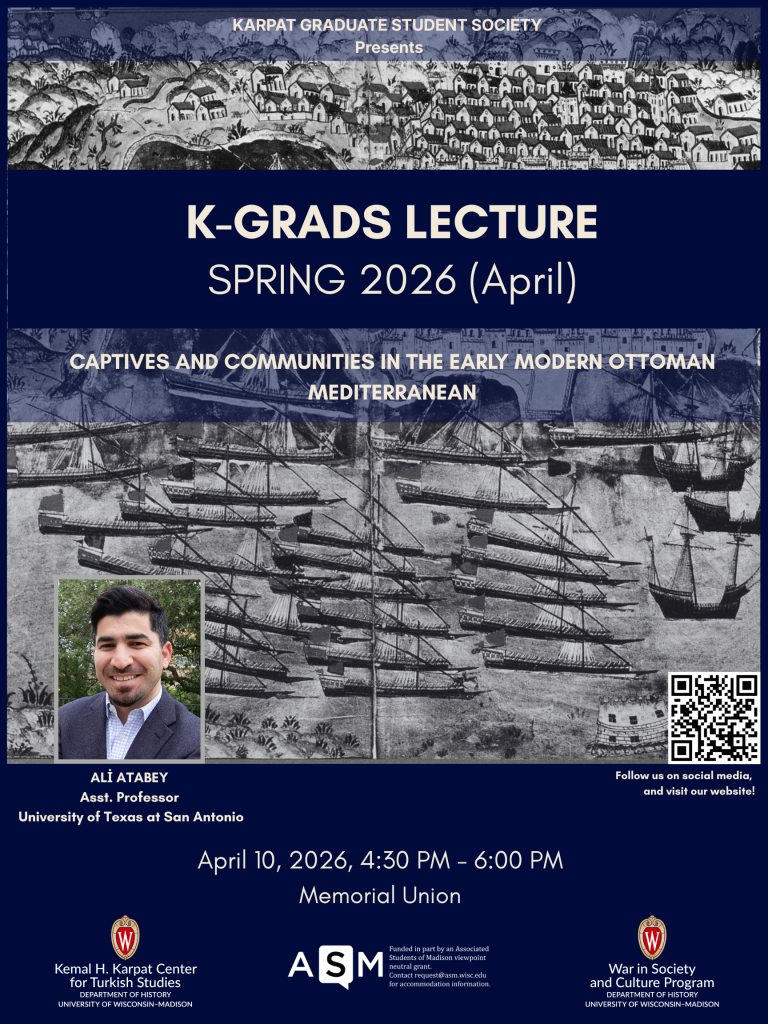
Lecture: “Captives and Communities in the Early Modern Ottoman Mediterranean”
This event has passed.
Memorial Union, check TITU
Professor Ali Atabey (University of Texas at San Antonio)
Due to the changing dynamics of the early modern Mediterranean, the seventeenth century witnessed a marked rise in captive-taking, affecting thousands of Ottoman subjects who traveled the region as merchants, soldiers, and pilgrims. This talk examines the redemption and post-captivity experiences of Ottoman subjects through Ottoman legal records, fatwas, complaint registers, and registers of important affairs. It emphasizes three interconnected themes: how captivity was understood in Ottoman society from legal and cultural perspectives; how courts and state institutions shaped the processes of redemption, return, and reintegration; and how families, neighbors, friends, and wider communities played a crucial role both in securing captives’ release and in supporting them after their return. By foregrounding these communal dimensions, the talk argues that captivity offers a valuable lens to understand law, social solidarity, and everyday life in the early modern Ottoman Mediterranean.
Ali Atabey is an assistant professor of history at the University of Texas at San Antonio. His research focuses on early modern Ottoman and Mediterranean history. He specializes in the social and legal history of the Ottoman Empire, with a particular emphasis on ethnic and religious communities and urban space. He has published on various topics, including piracy, captivity, slavery, and gender in Ottoman legal culture. He is currently working on a monograph that explores the relations between Muslims and non-Muslims in early modern Istanbul.
This event is sponsored by ASM (Associated Students of Madison), the Kemal H. Karpat Center for Turkish Studies, and the War in Society and Culture Program at the Department of History.