Past Event Category: Sponsored by MESP
-
 Oct 11The struggle for Salafism in the Egyptian Transition (2011-2013)
Salafism was the religious language that dominated Egypt’s aborted political transition in the wake of the fall of Mubarak. The leading and most vocal political actors of the moment all mobilized strands of Salafism in a a religious fight for legitimacy against each other: the Salafi Call and its political party al-Nour (with its internal divisions), Hazim Abu Isma’il and his revolutionary Salafis, and even the Muslim Brotherhood, whose religious references had earlier been distinct from Salafi ones. Why was that the case? And how does this shed light on some of the transition’s dynamics (and eventual shortcomings)?
-
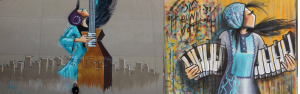 Oct 4Stories on Afghan Women, Art, and Everything in Between
https://uwmadison.zoom.us/meeting/register/tJIudOmsrjMuE9xJPajsh1tBSR3nIoHrm0E
Our community continues to be touched by Middle East displacements and conflicts with the latest development in Afghanistan and the ongoing Afghan refugee crisis. Given the urgency of this issue, we are honored to host this meaningful and pressing panel.
-
 Sep 27Time Will Be the Judge: Tawfiq al-Hakim, Taha Husayn, and the Competing Factions of 1930s Egypt
Rather than identifying the essence of Egypt, these authors asked their readers to understand national identity as a contingent construction that could be altered. In plays, interventions in public debates, letters, and a jointly written novel, al-Hakim and Husayn sought to distinguish the eternal realm of mythology and art from the constantly altering world of human affairs.
-
 Sep 13Arab Americans: We’re Not White, with Comedian and Professor Amer Zahr
We will discuss Amer’s upbringing as an Arab American, how comedy and law intersect, and how it is possible to reconcile multiple identities. We will also talk about how American society and politics affect the lives of immigrants in general and Arab-Americans in particular.
-
 Sep 13Arab Americans: We’re Not White, with Comedian and Professor Amer Zahr
Online via Zoom
Amer Zahr, founder and producer of the annual 1001 Laughs Ramallah Comedy Festival, is a rising star in both the US and the Middle East. Amer is an Arab-American comedian, speaker, political activist, writer, and adjunct professor at the University of Detroit, Mercy School of Law
-
 Apr 19Mosques and Islamist Activism: Spatial Evidence from Interwar Cairo
A supplementary analysis shows that the Muslim Brotherhood was more likely to establish health services in areas that had previously seen mosque activities. These findings deepen our understanding of the conditions under which certain mosques become sites for Islamist mobilization, and demonstrate how historical spatial data can be utilized to study political activism.
-
 Mar 29The Adverse Effects of the Pandemic on MENA Research
Shalaby argues that while the pandemic has interrupted most scholars’ research plans, researchers who study the Middle East and North Africa (MENA) region are more likely to encounter higher barriers
-
 Mar 8Joint Struggle: A Decolonial, Abolitionist approach to Middle East Studies
Professor Naber will analyze the limits and possibilities of coalitional BIPOC movements in the U.S. that have strived to end anti-Blackness and U.S. imperialism simultaneously. Professor Naber will develop her analysis through the lens of decolonial feminisms while focusing on the significance of coalitional politics, or “joint struggle,” to the field of Middle East Studies.
-
 Feb 22A Gordian Knot in the Ottoman East: Kurdish Nobility, the Ottoman State, and the Question of Fiscal Autonomy in the Long Nineteenth Century
This talk discusses the making and the eventual dissolution of the Kurdish nobility in the Ottoman realm with a specific focus on land ownership and its transformation during the Ottoman reform era of Tanzimat in the nineteenth century occupation.
-
 Feb 1Mystical Patriotism: Palestine and the Politics of National Dress
The production of the “virtual” nation of Palestine in film is associated with fabric artifacts, such as rugs and dresses, since the inception of Palestinian fiction cinema, or at least since the first international recognition of that cinema, thanks to Michel Khleifi’s Wedding in Galilee. These serve as metonymies of Palestinian-ness, reminiscent of paradise lost and reminders of a Palestinian cultural identity struggling against oblivion and imperialist cultural erasure.